07 January 2014

Photo gallery and a contest


What you see during a pilgrimage or an expedition is one of the most amazing aspects of the journey. The views, the landscapes, the unexpected and simple yet extraordinary moments, the faces of fellow pilgrims, your own appearance after you have just walked 30 kilometres in pouring rain and still was able to reach your albergue, the focus and sense of purpose on the faces of the faithful in Lourdes, the animals and the wildness in the Pyrenees, the albuergue where the day before you spent the whole evening laughing and drinking wine. These and many, many other instants, this is your journey. And they can be immortalised by something so straightforward as a camera.

I have taken a lot of photos, more than a thousand during my 40 days of the expedition, and I have been sharing some of them with you in the posts. Now, to make it more convenient, I have just added a small icon with a slide show just below the most popular posts on your left. Scroll a bit down and you will see an illustration changing every now and then. (I am sorry about the resolution, nothing I can do about the settings of the blogger ;) ) When you click on it, you will be taken to my Flickr account where I have uploaded all of the photos from the blog. And there are new photos coming up. I hope you will enjoy them. ;)

One more thing, so far I have been telling you my story from my own point of view. And since I realise that each of us can look at the world a bit differently and be interested in distinct aspects, this seems incomplete. For this, if you have time and if you want to, I will be waiting for your comments or your questions about my or any other expedition / pilgrimage / journey until Sunday. You can send them directly to the following e-mail: 

projectpilgrimage2013@gmail.com 

For the most interesting ones, five additional and unpublished photos from my pilgrimage. Enjoy the pictures!

Edit: The comments/questions with answers from me will be published in one of the posts next week. ;)

06 January 2014

Fighting the injury

08.10-09.10.2013

I stayed in an albergue in Villafranca del Bierzo resting for almost all afternoon and evening wondering what I should do the next day. And as it happens in life, so it did on my pilgrimage and I was given what I exactly needed at the time. One of the people working for the albergue came up to me when I was lying on my bed, we talked, he asked about the leg and then told me what exactly was the problem. Also, he gave me some advice on how to treat it and what to avoid and since that my leg was improving every day until Santiago. It still was a few days before I walked for the first time without feeling any pain and I continued to limp until I reached the cathedral in Santiago de Compostela but I was able to walk and it was a reason to be happy. In the evening of the next day, together with a woman from New Zealand (we have helped each other a lot on your way up O Cebreiro and if you happen to read this report, thank you for the company walking up the mountain!) and two guys from Germany, I have made it to the top of O Cebreiro having walked 30 km. I was really proud that I had been able to hike that much with the injury. The village has developed in a very close relation to the Camino de Santiago, although, now it is also a popular tourist destination. To be honest, when I was entering it I heard two people talking and one of them was saying that this is a place through which pilgrims to Santiago pass. 26 people live on a permanent basis in O Cebreiro and the albergue run by the Xunta de Galicia (from Spanish, the government of Galicia) has 100 places for pilgrims. This fact shows how important is the Camino de Santiago for the village. Most if not all the buildings have been renovated and the effects make an impression on you when you get there. During the night, there are almost no lights around so you can see the stars perfectly. One of the Germans knew about the starts so when we were coming back from the dinner he was explaining all about them. The next day I was descending from the second mountain range in Castile and León and although going down was the hardest type of walking for my leg, I did arrive in Triacastela feeling okay. The leg was improving


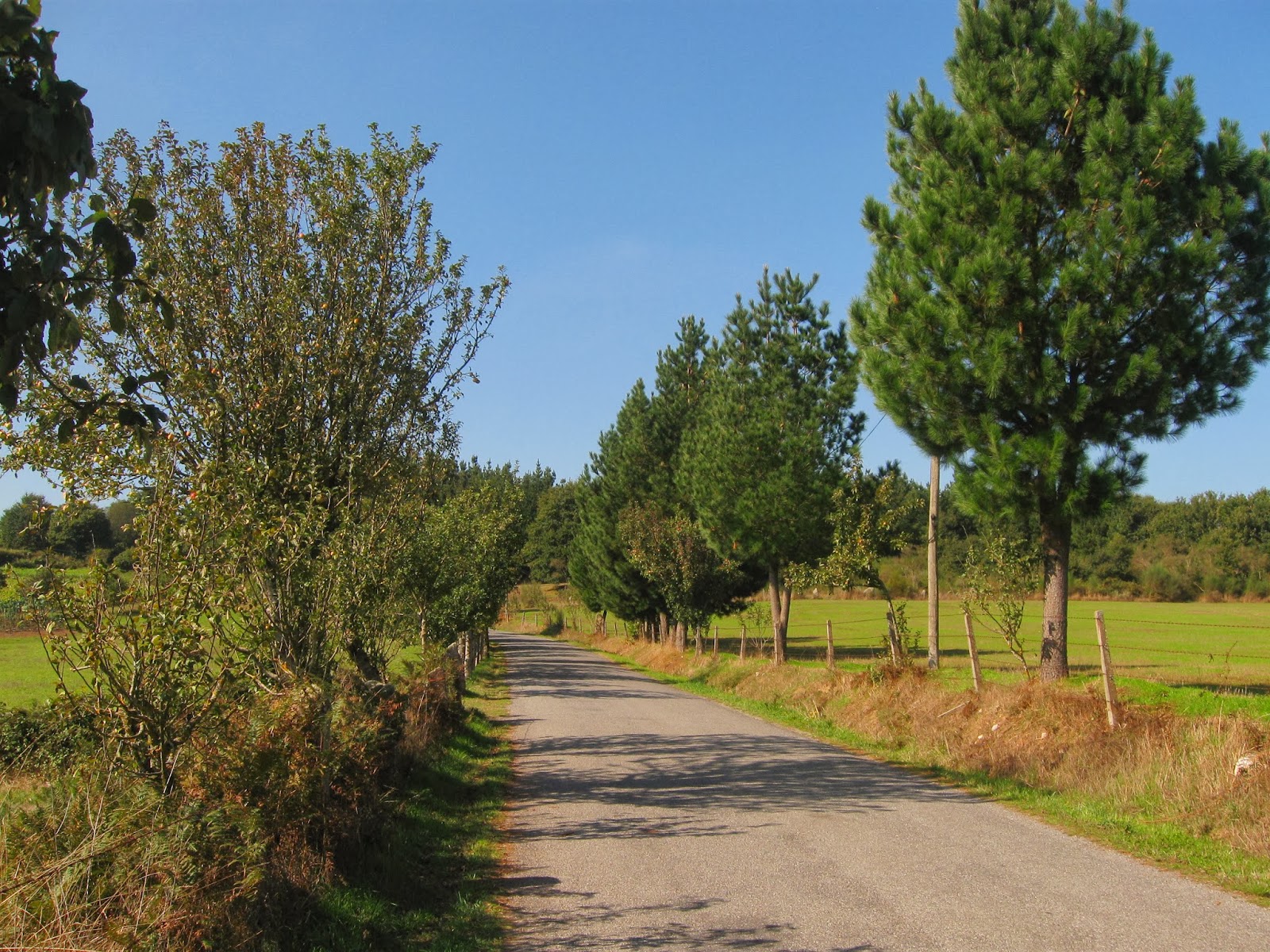
 Photo: Galicia, shortly before O Cebreiro, the Camino de Santiago

05 January 2014

A few words of gratitude

The project I am describing in this blog would not have been possible without the support and inspiration of many people. Because of this, an official “thank you” is more than in order. I hope you will not mind too much me taking few lines to do this. ;)

I would like to thank the Lord Rootes Memorial Fund for their trust in the project and the award that made it feasible. Also, to Dr Toni Haastrup for her academic reference and an invaluable advice, both on the project and throughout the Masters year. To Jakub Lasota, Isabel Ferrer Molina and Matthew Richards for their kind references and the support that cannot be overestimated.

To my parents, Krystyna and Grzegorz, for their efforts that have allowed me to carry on with both my studies at Warwick and the project presented here. To my brothers: Łukasz, for the unwavering support in times of need, and Tomasz, for the brilliant feedback on my initial project application. Also, to my aunt Elżbieta for her simple yet extraordinary help with the practical preparation for the expedition.

To friends and people of good will that I have come across before and during the expedition. Without meeting you, whether it was a discussion that we had, a supportive smile that we exchanged, the value of human kindness and companionship that you showed me, a life-saving car lift to Lourdes that I was offered, a diagnosis on my injured leg or an advice on how to continue on the coming 550 kilometres, without each and every one of these, and more, my experience of a pilgrimage would not have been the same. Thank you whether you are in Belarus, Belgium, Brazil, Bulgaria, Canada, France, Germany, Ireland, Italy, Lithuania, Poland, Romania, South Korea, Spain, Taiwan, the United Kingdom, the United States or Ukraine.

Finally, to all of you reading this blog for the effort you make. Without it, I would definitely not have that much motivation to go on publishing new posts. ;) Also, for the smile caused by a quick glimpse at the statistics. ;)

A small gift for all of you:


Photos: The Pyrenees, a view from the Camino de Santiago and Galicia, the Camino de Santiago

04 January 2014

A moment of crisis

04.10- 07.10.2013

León was one of the most beautiful places I have been to during my pilgrimage and I would like to be back there one day. It was also a place where together with two friends we have discovered that the night before we were attacked by bed bugs. They are a nuisance on the Camino de Santiago which is hard to avoid. Despite the extensive measures undertaken by the owners of the albergues, on occasion you might be bitten by bed bugs when you sleep. The bits are not dangerous in any way, they simply annoy you since they are very itchy. The only problem is to make sure that you do not take them with you when you go home after reaching Santiago. There are two things you can do, one is to use a certain chemical substance I did not want to use because of its smell, two is to wash all your clothes after you have been attacked. So the three of us were washing everything at the same time when we discovered what had happened the night before. On the plus side, the washing machine and the drying machine were available to everyone for free in our albergue so we did not even have to pay for them. A day after León I have stayed in a town called Hospital de Órbigo in an albergue verde. (Spanish for a green albergue) It was one of those extraordinary albergues on the Camino de Santiago and it was run by two great Spanish people who were vegetarians. Everything inside was ecological or prepared in an ecofriendly way, the symbol of a snail was all around the place, the people who were staying there were more than friendly, there was a dog running around and during a communal mean we all shared you had a great chance to socialise with everyone. An extraordinary place. There were more of them on the Camino de Santiago.

After I left the albergue in the morning and walked 15 km more, I arrived in Astorga which is where a region called the Maragatería begins. As my guidebook says, the Maragatos, of an unknown ethnic origin, are proud people with unique customs and high respect for honesty. In the area you can see many ruined buildings which make you pause for a moment and reflect. Few metres from them there will be buildings that have already been renovated during the economic recovery of the region that is due, to an important extent, to surging popularity of the Camino de Santiago in the last 15 years or so. A place worthy of a visit, not only during a pilgrimage. Even more so as it is where the so-called Cruz de Ferro is located. Originally, a sign for pilgrims crossing the mountains that was supposed to guide them, it is a place around which a tradition has developed. Pilgrims who arrive there are carrying a stone from their home country or hometown and then they leave it there as a sign of having gotten rid of a negative feature or character trait of their own. There is a circle of stones of around 30 metres in diameter at the bottom of the cross now. 

 
When you leave the Maragatería you enter another region that deserves a recommendation, el Bierzo. Not known outside of Spain, in this country it is famous for its wine and the beautiful landscape. In fact, the Camino de Santiago crosses through Cacabelos, a town in the heart of the region, and shortly after that you yourself walk though the vineyards and observe how people of the area tend to their fruit from which an excellent final product will be produced. Even if you do not drink wine, to see a place full of vineyards located in-between two mountain ranges is in itself an unforgettable experience. However, as the Camino de Santiago crosses northern Spain, it on occasion goes also through places which are less beautiful and more industrial. It is the case, for example, with Ponferrada, a city located at the border between Maragatería and el Bierzo. Although it has a location that is hard to beat in terms of the beauty of the surrounding areas, the city itself is not that pleasant, if not, simply speaking, ugly. Very industrial it does not fit well with what you see before or after it. Another example of this contrast would be Burgos and its outskirts. The city centre with its old building, an impressive cathedral and cosy traditional Spanish restaurants and bars is, in this case, complemented by industrial areas the you are crossing through when you both enter and leave the city. For instance, for some 15 minutes you are walking next to the fence of an airport. This contrasting places are yet another of the things that you see when on a pilgrimage. As I said before, I have not been spared physical difficulties on my expedition. After I have crossed the first mountain range in Castile and León, I have developed a condition called tendinitis on my right leg. Having rested in Ponferrada I was hoping to be able to continue the day next. And I was walking but it was far from good and I was feeling the pain. The worst part was that it was not disappearing, it was getting stronger. So strong that around 3 km before Villafranca del Bierzo I simply had to sit down on the ground as I could not make another step forward. This has been a moment of a crisis and I was not sure that I will be able to continue. I have rested for some time and then I managed to somehow walk those missing 3 km to Villafranca where I went to an albergue. 

Photo: El Bierzo, the Camino de Santiago

03 January 2014

A Short Video

As has been promised, below you will find a short video that serves as a type of introduction or a trailer for the results of the investigation about the meaning of a pilgrimage. A word of warning and advice. Due to the copyright issue, I decided not to add music background to the video to avoid violating the rights of others. However, if you do not want to listen to a silent series of images, I would advise you that, before you hit play, you go to probably the most popular website with videos on our planet. There, you put “Find Yourself - Brad Paisley lyrics” in the search engine and you choose the first video available with some lyrics already visible. Try to start both the song and a short video almost at the same moment so they become two parts of the same whole. Enjoy!

PS. Having re-considered it, I am adding a direct link to music background --> just click where it says Music Background. ;)


http://www.youtube.com/watch?v=c80TFtL9c6k

02 January 2014

Questions I have been asking

As I mentioned in the very first post, apart from living my own pilgrimage during the realisation of the project, I have been also investigating what does a pilgrimage mean for other people. Given the varied situations in which I could find myself during the expedition, it resulted impossible to follow a structured and organised pattern in terms of the questions I was asking. Because of this, I have decided to adopt a different approach. During the research process conversations, observations and reflections on what I had heard or experienced each day were guided by a set of questions presented below. In this way, it is believed, the coherence and academic quality of the findings of the project could have both been ensured. At the same time, every effort has been made not to unduly distort the research by the assumptions made beforehand, something considered an equally vital task. Also, the possibility of the additional issues to be considered has been taken into account. Overall, the question about the meaning of a pilgrimage in the 21st century has been tackled in this way.

Questions guiding the investigation:
• Why do you make a pilgrimage / hiking trip?
• Why this particular type of a pilgrimage / hiking trip?
• How did you come up with the idea of making a pilgrimage / hiking trip?
• In what situation did you decide to do a pilgrimage / hiking trip you are doing now?
• Do you have any expectations regarding your pilgrimage / hiking trip?
• If yes, what are the expectations? If no, why you do not have any expectations?
• For who, if anyone, are you doing a pilgrimage / hiking trip?
• What unites different types of pilgrimages / hiking trips?
• What differentiates different types of pilgrimages / hiking trips?
• How similar are different types of pilgrimages / hiking trips?
• How different are different types of pilgrimages / hiking trips?
• What have you experienced so far?
• Does it differ from what you have been expecting before the pilgrimage / hiking trip?
• Are the expectations of different people somehow connected with the types of pilgrimages?

PS. A short video / trailer presenting the results of the academic part of the project will be posted soon. ;)

01 January 2014

Crossing la meseta

27.09-03.10.2013

A pilgrimage is also pain, including but not limited to physical suffering, effort and fighting. I was reminded of that when in Burgos one of my friends from Lithuania had to take two days of rest because of an injury. She was not, by any means, the only person that felt the consequences of walking every day for hours. My turn was only coming and it is going to catch up with me in the next journal entry. ;) Some of the people I have met or heard about had to make hard decisions to fly back to their countries or cities before reaching what they were hoping to reach. In fact, when on the Camino de Santiago you walk next to a grave of a pilgrim on several occasions, especially, during the first part. The majority of them died due to the physical effort they have undertaken. Few have been killed in car accidents. I am not saying that here to discourage anyone from going on a pilgrimage. I could not be further from that. I am simply stating that it is not easy. It is good to bear this in mind when you are about to travel into the unknown. This also makes the experience so much more real. Anyway, when you leave Burgos you enter what the Spanish call la meseta. It is a vast plateau in the heart of peninsular Spain through which you walk for several days crossing corn fields, corn fields and more corn fields. Some people complain that the landscape is simply speaking boring and does not stand a chance in comparison with Navarra, La Rioja or Galicia. Although it is very different from what you see in those regions, I disagree with the conclusion. It has its own beauty. And mystery. When you are there and you can see what is waiting for you during the next few kilometres, in this moment, without any warning, there might be a small valley in which there will be a town. They were invisible just minutes ago because they are located some 20-50 metres below the level of la meseta. You would not expect them to be there, yet the next moment you walk right through them.

The small villages. They are another element of a pilgrimage. In contrast to a tourist trip where you mostly drive next to them on a highway, here you visit them, you stay there to have lunch, you rest there, you sleep there. As I did whether it was Hontanas, Boadilla del Camino, Terradillos de los Templarios, Calzadilla de los Hermanillos or many others. While there, in the evening, you can sit in front of an albergue and watch the peaceful life of a village. Something that would brightly stand out if you thought about life in London, Madrid, Warszawa or some other big modern city. The value of a pilgrimage in this respect is that otherwise it would have been very difficulty to see a small pueblo (Spanish for a village) from inside. And the tranquillity and peacefulness you experience are worth walking even 30 km a day. If I have not mentioned that already, in the Pyrenees and on the Camino de Santiago there is something like a daily pattern. The usual day, if you will. Of course, there are exceptions and variations, but if one asked about the typical activities, it would be something like this. You wake up early in the morning, some go as early as 5 am, my usual time was between 5.45am and 6.30am. Then you take care of the morning duties, eat your breakfast, pack and go. Depending on the day, walking would take anything from 3-4 hours to 10 hours. The earliest I arrived in an albergue was 11am, the latest 7.30pm. When you finally get there, it is first shower, unpacking a little bit, washing your clothes, then relax, recovery, some visiting of the city/town you are staying in if you feel like it, a dinner most often together with wine (especially on the Camino de Santiago), talking, laughing, more visiting and then sleeping before the efforts of the next day. Most pilgrims go to bed around 10pm, in my case, several / many times I went to bed later but sometimes I was asleep at 10 pm too. This would be a typical or stereotypical day of a pilgrimage.


I have mentioned la meseta above. If you wanted to describe my pilgrimage in more detail in terms of geography, there are several different broad categories. La meseta, with its flat surface and corn fields would be one of them. Another would be the mountains, whether it were the Pyrenees near Gavarnie, the Pyreness which I was crossing after leaving Saint-Jean-Pied-de-Port or the mountains of León in the autonomous community of Castile and León. The third category would be the cities with their busy streets and crowds of people, such as Lourdes, Pamplona, Logroño, Burgos, León or Santiago de Compostela to name the biggest ones. The final one would be the areas with a significant number of hills and small valleys with rivers where you often climb first and then descend only to be soon climbing up again. The view you see in those places is often hard to describe appropriately with words. Roncesvalles to Burgos, León to Astorga and Triacastela to Santiago de Compostela – this is where the fourth geographical type can be found. What differentiates la meseta from the other areas are the long stretches of solitary walks where you can see nothing but trees, fields and nature for, for example, 22 km as is the case between Calzadilla de los Hermanillos and Mansilla de las Mulas. There used to be more of those on the Camino de Santiago, but the development of infrastructure limited their number. Nevertheless, you will still sometimes find yourself walking and walking, and walking for hours at the time without a town or a city. In this way, mixing solitary hikes, corn fields and small villages, I arrived in León.

Photo: La Rioja, the Camino de Santiago